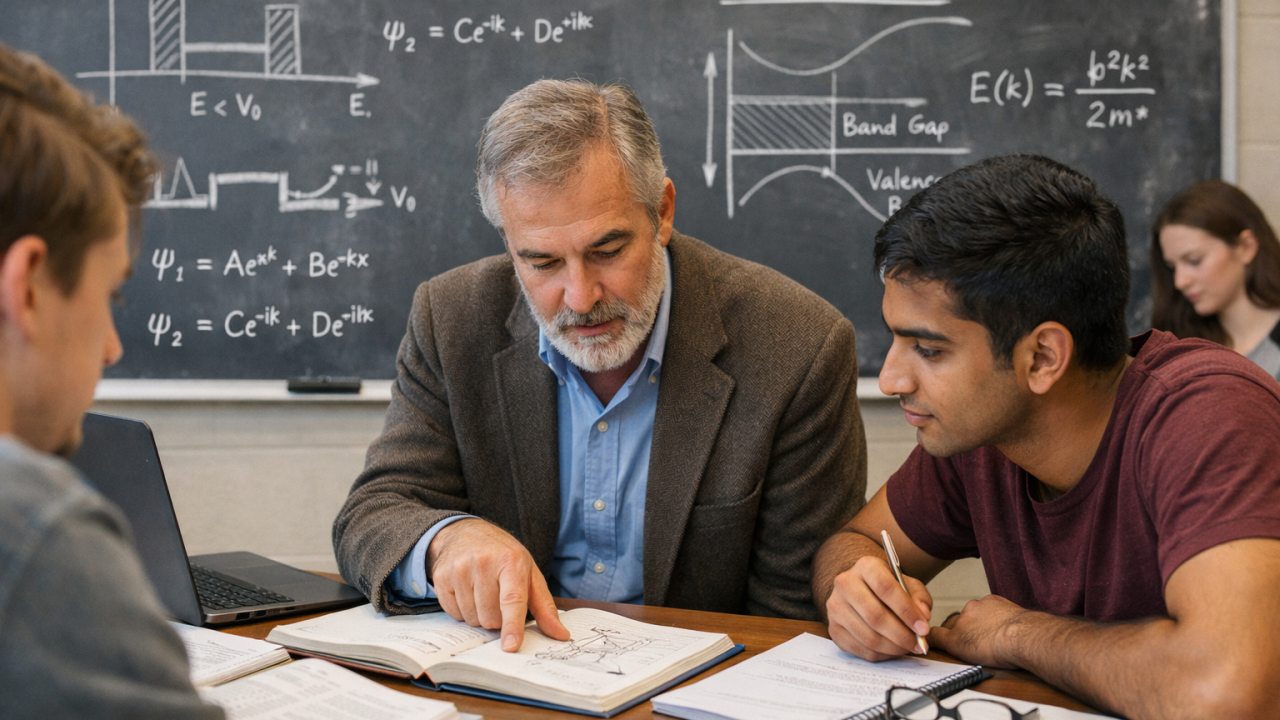
A Physics solution can seem completely logical when someone else explains it. The diagram is clear, the equation fits and every calculation follows. Then the student faces a similar question alone and cannot decide where to begin. Understanding a presented method and generating a suitable method are different demands.
The question behind a search for Best Physics Tutor is often whether teaching will help a student cross that gap. A useful lesson should do more than make a solution easy to follow. It should help the learner identify the physical model, choose an approach and check the result when the prompts disappear.
Identify What the Worked Solution Is Doing for the Student
A worked answer quietly provides decisions that students may not notice. It selects the system, identifies relevant information, chooses a principle and organises the mathematical steps.
Following the calculation does not test all those choices. A student can understand that 9.6 divided by 1.2 equals 8 without knowing why either quantity belongs in the problem.
Before reviewing another complete solution, ask which decisions are already supplied. Does the heading identify the topic? Is the useful equation printed beside the question? Has a diagram already marked the relevant forces or height?
These supports can be helpful while learning. Difficulty arises when they remain present throughout practice, so the student never has to reconstruct the method.
The aim is to withdraw support in a controlled way while keeping the reasoning visible.
Separate Planning from Calculation
Ask the student to state the requested quantity, describe the situation and propose a principle before entering any numbers.
This short planning stage exposes a common transfer problem: searching for an equation containing the visible symbols without checking whether it describes the situation.
For an energy question, the student should identify the initial and final states and examine energy transfers. For a force question, they should define the object and account for the forces acting on it.
The same planning routine does not mean every Physics problem has the same solution. It provides a place to make the important choices before arithmetic distracts from them.
A student who cannot explain the plan needs support at that stage. Giving the next calculation may produce a finished answer while bypassing the difficulty.
Examine an Energy Solution Beyond Its Algebra
Consider an illustrative question involving a 1.2-kilogram block released from rest on a smooth track. It descends through a vertical height of 0.80 metres. Take gravitational acceleration as 10 metres per second squared and neglect air resistance.
The decrease in gravitational potential energy is mgh, which gives 9.6 joules. With no energy dissipated, this becomes the block’s kinetic energy.
Using ½mv² = 9.6 gives a speed of 4.0 metres per second.
A student may follow this calculation readily. To assess independence, ask why the vertical height matters rather than the total distance travelled along the track. Then ask why gravitational potential energy can be equated to kinetic energy under the stated assumptions.
Explain why the method fits
The information specifies a change in height and the absence of dissipative effects. An energy comparison connects the initial and final states without requiring the detailed shape of the track.
Using a constant-acceleration equation along the entire path would require assumptions the question has not supplied. The student should be able to explain this distinction rather than regard the energy equation as a remembered shortcut.
Change one condition
Now state that 2.4 joules are dissipated during the descent. The available kinetic energy becomes 7.2 joules.
The relationship is therefore ½ × 1.2 × v² = 7.2, giving a speed of approximately 3.5 metres per second.
The numerical change is small, but the reasoning change is important. The student must replace the assumption that all the lost gravitational potential energy becomes kinetic energy.
If they repeat the original calculation unchanged, they have remembered the solution’s shape without applying its conditions.
Ask for Predictions Before Numerical Answers
A prediction can reveal understanding that a calculation conceals. In the modified example, the final speed should be lower because less energy is available as kinetic energy.
Ask the student to state this before calculating. If the numerical result is larger, they have a reason to investigate their method.
Other useful predictions concern which quantities should or should not affect the result. In the ideal smooth-track example, the mass cancels from mgh = ½mv². For the same vertical drop and stated assumptions, changing the block’s mass does not change the predicted final speed.
However, this conclusion should not be carried automatically into the modified question. A specified fixed energy loss must be handled according to its wording. Conditions determine what can be generalised.
Predictions should therefore include a reason and an assumption, rather than become another set of facts to memorise.
Withdraw Prompts One Decision at a Time
Removing all support immediately can make a task unproductive. Keeping every prompt can hide dependence. A more informative approach reduces assistance at specific points.
Initially, the student might explain the missing steps in a partly completed solution. Next, they could select the principle while receiving help with the diagram. Later, they could construct both the representation and the plan independently.
Record what assistance was needed. “Solved with a reminder to compare initial and final energy” is different from “selected and completed an energy method independently”.
This makes progress visible without exaggerating it. It also helps a tutor decide what the next task should test.
Avoid using the completed answer as the only evidence. The amount and nature of help matter when judging whether the method is available independently.
Vary the Decision, Not Only the Numbers
Changing a mass from 1.2 kilograms to 1.5 kilograms may provide calculation practice while leaving the reasoning almost identical.
For transfer practice, vary something that requires a new choice. Ask for a height instead of a speed, include an energy loss or describe the initial state with a non-zero speed.
The purpose is not to make every question more difficult. It is to reveal which parts of the original method remain valid and which need adjustment.
Once a student handles these variations, mix the question with tasks from other appropriate topics. Removing the chapter heading forces them to identify the principle from the situation.
Keep the demands suitable for the course. Upper-secondary students should practise within their syllabus, while H2 or IB students may need more complex models and connections.
Build a Check That Belongs to the Physics
Independent problem-solving includes evaluating the answer. A calculator result is not a complete check.
In the smooth-track example, the energy balance should be consistent with the stated assumptions. In the dissipative version, the calculated kinetic energy should equal the potential energy decrease minus the specified loss.
Units also help. An energy calculation should produce joules; a speed should have units of metres per second. A mismatch can expose an incorrect relationship or unfinished calculation.
Ask the student to explain whether the magnitude and direction of a result are plausible where relevant. These checks should be chosen for the particular problem, rather than added mechanically.
Judge Support by the Independence It Creates
A productive teaching session leaves the student with decisions they can now make more reliably. Confidence matters, but it should be connected to evidence from unaided attempts.
TGC ACADEMY describes structured resources, demonstrations and personalised attention within its Physics teaching. Students considering this approach can ask how support is reduced as understanding develops and how unfamiliar questions are used to check independent application.
Keep a small record of plans, predictions and the prompts still required. Review it alongside completed work. If the same cue is repeatedly necessary, practise that decision rather than adding another complete model solution.
The eventual aim is a student who can read a situation, choose an appropriate model, explain the conditions and evaluate the outcome. Worked solutions contribute to that process when they expose the reasoning and then leave space for the learner to supply it.
